Executable scholarly edition · Clavis, p. 251
Modus II: from printed letters to German
Follow one worked example from the printed page through transcription and extraction to a mechanically recomputed plaintext. Every visual has an equivalent table or prose account.
1. Printed example
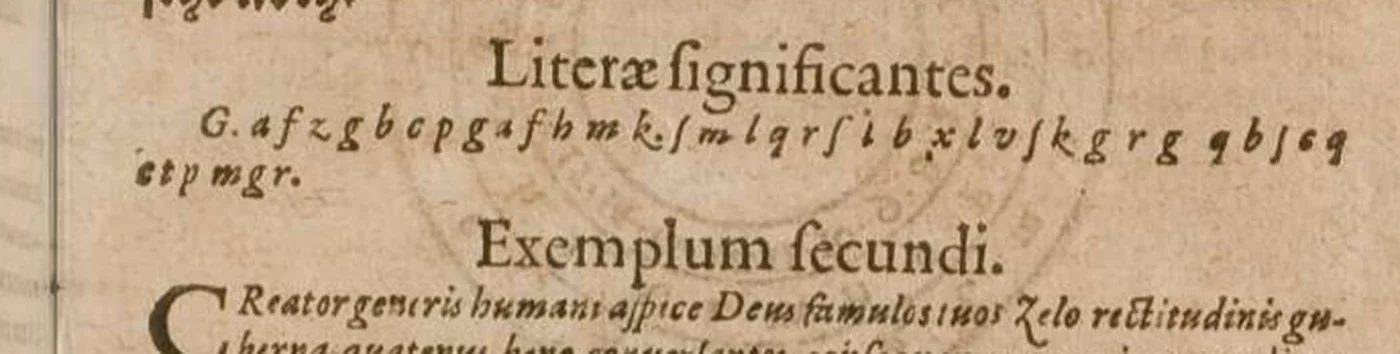
Printed evidence
Intentio: Ich bittedich komm von stund an zu mir es thut sehr noth
English: I beg you, come to me at once; it is very urgent.
Open the containing work (segment alignment; The stable passage index identifies the printed Intentio within this containing source segment.)
2. Transcribe and extract
Transcription / repair OCR-preserving sample of the Latin Exemplum. After the initial printed marker, alternate words are significant; their initials are read in order. OCR errors remain unresolved, so this sample demonstrates the extraction rule but is not silently forced to agree with the separately printed cipher line.
C Reator genyri humani apice Deus famelis suor Zelo rellitudine gu berna quatenus bene conueniant sancti celestiumus praemium gaudium exultium
Initials from the bold alternate words: gafzgqccg
Inferred operation For the cover, take the initial of every alternate significant word after the marker. For the separately printed Literae significantes, read each period-separated letter from left to right and remove separators without reordering.
Human/vision reading of the printed, period-separated letter line; periods are editorially represented as separators.
Transcribed dotted letters: g.a.f.z.g.b.c.p.g.a.f.h.m.k.s.m.l.q.r.s.i.b.x.l.v.s.s.k.g.r.g.q.b.s.e.q.e.t.p.m.g.r
gafzgbcpgafhmksmlqrsibxlvsskgrgqbseqetpmgr
3. Invert the printed Alphabetum
Printed evidence Each first letter is plaintext; each second letter is its printed cipher substitute.
| Plain | a | b | c | d | e | f | g | h | i | k | l | m | n | o | p | q | r | s | t | v | x | y | z | w |
|---|---|---|---|---|---|---|---|---|---|---|---|---|---|---|---|---|---|---|---|---|---|---|---|---|
| Cipher | z | w | a | b | c | d | e | f | g | h | i | k | l | m | n | o | p | q | r | s | t | v | x | y |
Inferred operation Invert the printed plaintext-to-cipher Alphabetum and substitute one letter at a time.
4. Read the computed result
Computed from the committed transcription:
ichaiderichkomvonstvldznyvvmitisdvgsgxroit
Printed Intentio, normalized to the same 24-letter alphabet:
ichbittedichkommvonstvndanzvmiresthvtsehrnoth
The difference is evidence about the transcription, not a failed cipher rule. The edition displays both strings so readers can test alternative letter readings against the scan.
| Position | Cipher | Decoded |
|---|---|---|
| 1 | g | i |
| 2 | a | c |
| 3 | f | h |
| 4 | z | a |
| 5 | g | i |
| 6 | b | d |
| 7 | c | e |
| 8 | p | r |
| 9 | g | i |
| 10 | a | c |
| 11 | f | h |
| 12 | h | k |
| 13 | m | o |
| 14 | k | m |
| 15 | s | v |
| 16 | m | o |
| 17 | l | n |
| 18 | q | s |
| 19 | r | t |
| 20 | s | v |
| 21 | i | l |
| 22 | b | d |
| 23 | x | z |
| 24 | l | n |
| 25 | v | y |
| 26 | s | v |
| 27 | s | v |
| 28 | k | m |
| 29 | g | i |
| 30 | r | t |
| 31 | g | i |
| 32 | q | s |
| 33 | b | d |
| 34 | s | v |
| 35 | e | g |
| 36 | q | s |
| 37 | e | g |
| 38 | t | x |
| 39 | p | r |
| 40 | m | o |
| 41 | g | i |
| 42 | r | t |
Plain-text account
The scan prints an explicit alphabet, an intended German message, and a dotted line of significant letters. We transcribe those visible letters in order and remove only their separators. We then reverse the printed alphabet and replace each cipher letter with its corresponding plaintext letter. This produces ichaiderichkomvonstvldznyvvmitisdvgsgxroit. It only partly agrees with the printed intention, so uncertain readings are left unresolved rather than silently changed.
Provenance and limits
- Facsimile crop derived from the corpus scan of printed page 251.
- Cipher-line transcription confirmed by human inspection against a vision-assisted read; unresolved letter readings remain visible through the mismatch.
- The plaintext Intentio and explicit Alphabetum are printed on the same page.